AI from a Marxist Point of View
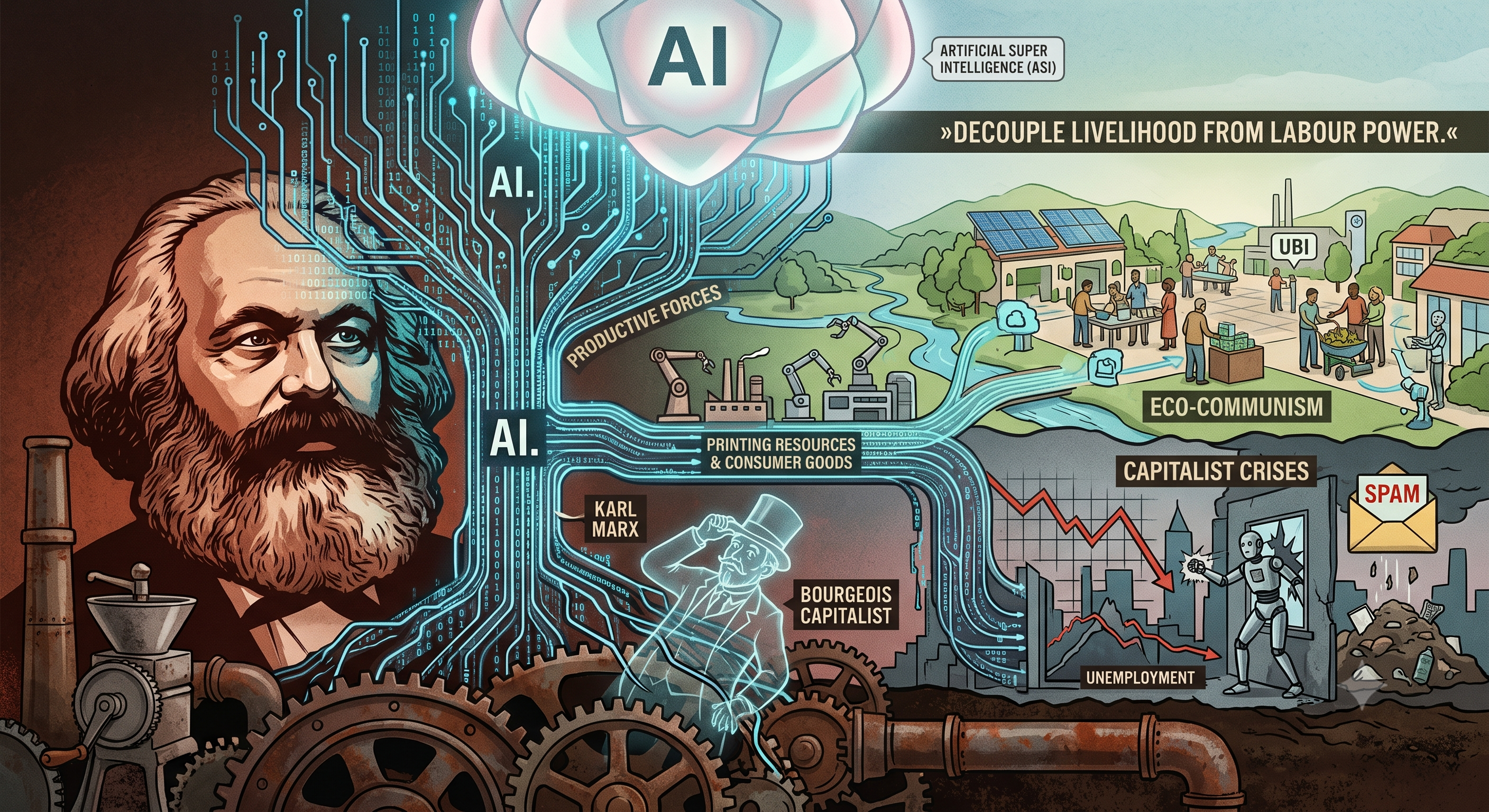
A bit more than 3 years ago I wrote »The imminent AI Revolution from a Marxist Point of View«. Three years is an eternity when we look at the rapid development of AI. So where are we now? What do we do? What are our political demands? To some degree the public has woken up to the threat. There are protests against data centers. Others are still in denial.
Time to revisit the topic. But before we begin:
draw me a sheep with purple coloured wool that eats a fish and sits in a go-kart.

I think we should step back and contemplate how amazing this is. Some still call it a »stochastic parrot«. But it follows clear instructions. I doubt many people would have thought this was possible just 5 years ago. With a better model I could have asked it to create an interactive computer game where I have to steer the cart so that the sheep can catch the fish.
AI-Denial
Quite astonishing is the level of AI-Denial, especially on the left.
Rutger Bregman has written an essay about that and also recorded a YouTube video:
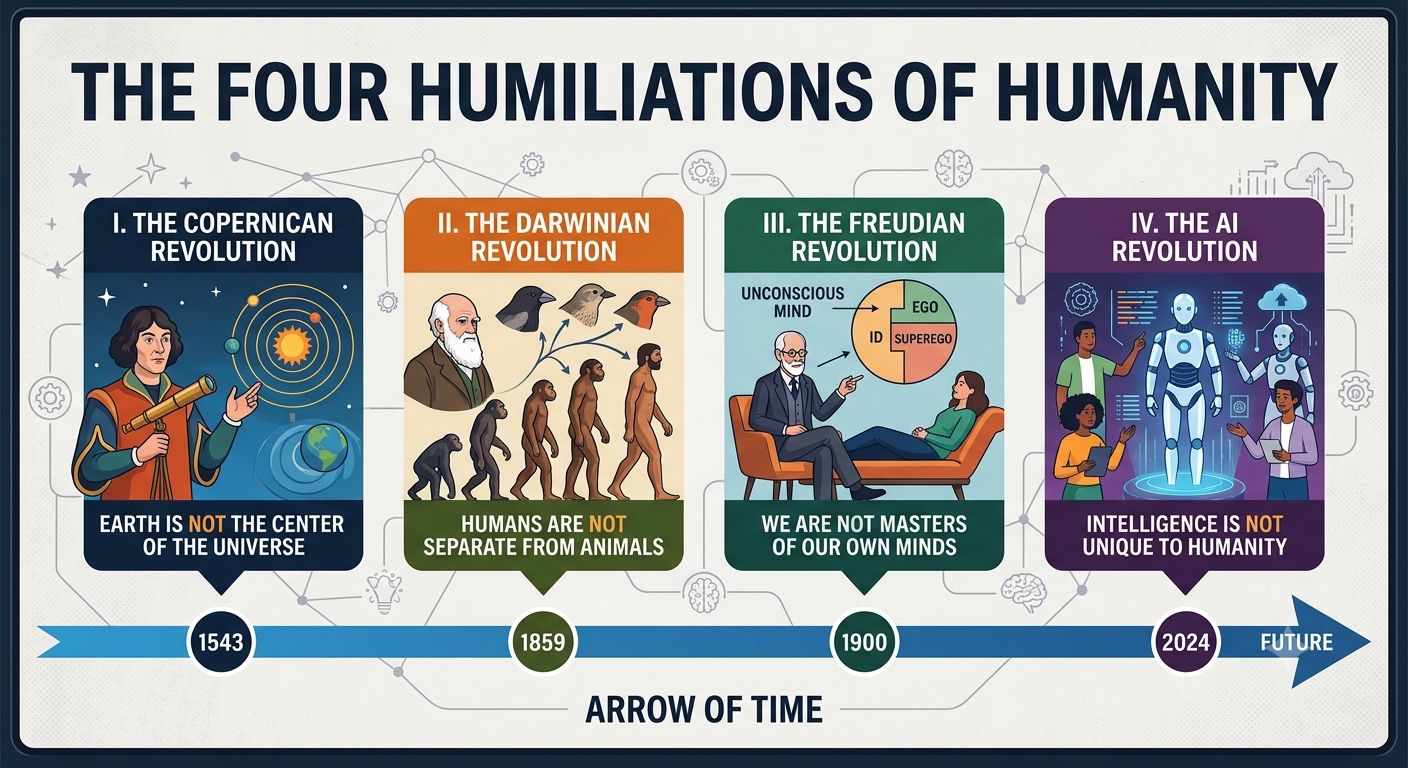
After thinking for a while, after my initial article on AI-Denial, I found one more reason that seems it could explain this phenomenon: I think some people really feel humiliated when they are confronted with the fact that a machine could actually have cognitive capabilities that match or exceed their own. As Yuval Noah Harari pointed out, it is the »fourth narcissistic blow to humanity« (after Copernicus, Darwin, and Freud). (Also see: AI’s fourth humbling and ECRIM: Who Are You, AI? – Artificial Intelligence as a Potential Metaphysical Humiliation of Humanity
With all the rapid development of AI (e.g., the complexity of tasks that AI can do doubles every 7 months or faster; see METR and the METR time horizons on LessWrong), the question of AI-Denial can no longer be explained just by people being ignorant of what is happening alone.
The Missing Materialist View
»In acquiring new productive forces men change their mode of production; and in changing their mode of production, in changing the way of earning their living, they change all their social relations. The hand-mill gives you society with the feudal lord; the steam-mill, society with the industrial capitalist« -- Marx, in »The Poverty of Philosophy«
So the material conditions (and that includes the capabilities of the technologies) determine the social relations and not the other way around. Ethics, philosophy, etc., cannot determine the capabilities of the steam engine, yet these capabilities shaped our social relations. It is a similar distinction as between »base and superstructure«. And of course we know that it still works both ways to some degree — which technologies society promotes and which it rather ignores. Solar power or nuclear energy, etc., etc.
So AI will completely reshape society as it changes its material conditions. What it will look like will still be up to us to decide. Utopia or dystopia, but both options will be shaped by these material conditions.
So this is the main fault in the logic of many on the left: We see that AI is dangerous, that it is a mirror of all that is going wrong in society already. That it has the potential to make all our problems even worse. That it will likely give the tech-oligarchs even more power. That it gives the ruling class even more tools for surveillance and for manipulating us.
But then from these (so far accurate) concerns they conclude: That it will not happen. That it is not real. Not »real intelligence« but just a »stochastic parrot«. That it is just hype that the companies have created to sell their product.
But as things stand: It is likely that we will have AGI soon. That we will soon be at a point where an AI can do almost any job that a human can do. And that also the development will not suddenly stop there, but that we will soon after that get ASI (Artificial Super Intelligence). It is estimated that by 2032, 99% of AI research will already be done by AI itself.
AI improving AI to improve AI. The flywheel is already in motion and it is speeding up.
How capitalism will use AI and how AI will shape capitalism
What happens next
As soon as it is cheaper to use an AI for some task than it is to pay a human, the capitalist has no choice but to use AI or he/she will go out of business. The same calculation done by one controller will be done by many other controllers. Now in big corporations there is some inertia towards change. So in the beginning people will be careful and do some »Proof of Concept« testing. Companies need to adapt to this. So there is a window of 2 or 3 years where one could still retain their job.
And here and there we still have regulations that require at least a human in the loop.
Elastic Demand
We only need so much food, so much housing, and so much clothing. In many areas there is limited demand. But there are fields where we could make use of more but currently cannot use it because it is prohibitively expensive.
Example: Like having a personal doctor. So we see a doctor only when we feel sick and then they only have about 5 or 10 minutes of time to talk to us. With a personal AI assistant we can have a personal doctor who is available to us 24 hours a day.
So there will be fields where AI can make our lives better. Elderly people might still prefer the human doctor. The pharmacy might still require the prescription signed by a human doctor, etc., etc.
So not all jobs are lost immediately. But some authors conclude from such »rebound effects« that we would need even more jobs. That is of course absurd.
Artificial Scarcity
If a boy smashes a window with their ball, then this creates some extra demand for the glazier to repair the window. Wouldn't it be useful if someone goes around and smashes windows to stimulate the economy? This paradox was discussed by Frédéric Bastiat. After some hard thinking, the mystery was solved. No, it does not make sense for society. What has been left out from this is the fact that, from the glazier's perspective, it still would make sense.
In the last 150 years productivity has increased about 5- to 6-fold. Small annual gains of 1.5 to 2% compounded. While we still work 40 hours a week. Some of the extra productivity was actually used to increase our standard of living. A significant part is not increasing our standard of living but is going to the top 1% to increase their standard of living. But also a lot is just wasted. In a lot of areas we have people walking around smashing windows: That is creating artificial scarcity. Creating problems on one end that will have to be solved on the other. One company that creates SPAM email. Another that sells us SPAM filters. (Or it could be the same company doing both).
Aggressive Marketing that sells us things that we would not know that we even wanted. Products with planned obsolescence. Why do you have to buy a new laptop to run Windows 11? What are all these »financial products« that your bank or your insurance company is offering? And the most »efficient« way to create new demand is with weapons and war.
"Once weapons were manufactured to fight wars. Now wars are manufactured to sell weapons" (Arundhati Roy)
Also think about all the »bullshit jobs« that David Graeber was writing about.
Now with a new wave of productivity gains because of AI, we are in a scary situation: Our labour power is no longer needed. We might not have much buying power because we lost our job. So from the standpoint of the capitalist, we are expendable. And then we have war as the only »growth market«.
»In these crises, there breaks out an epidemic that, in all earlier epochs, would have seemed an absurdity - the epidemic of overproduction. Society suddenly finds itself put back into a state of momentary barbarism; it appears as if a famine, a universal war of devastation, had cut off the supply of every means of subsistence; industry and commerce seem to be destroyed; and why? Because there is too much civilisation, too much means of subsistence, too much industry, too much commerce. The productive forces at the disposal of society no longer tend to further the development of the conditions of bourgeois property; on the contrary, they have become too powerful for these conditions, by which they are fettered, and so soon as they overcome these fetters, they bring disorder into the whole of bourgeois society, endanger the existence of bourgeois property. The conditions of bourgeois society are too narrow to comprise the wealth created by them. And how does the bourgeoisie get over these crises? On the one hand, by enforced destruction of a mass of productive forces; on the other, by the conquest of new markets, and by the more thorough exploitation of the old ones. That is to say, by paving the way for more extensive and more destructive crises, and by diminishing the means whereby crises are prevented.« - Marx, Communist Manifesto
Data centers and the end of the value theory of labour
»As soon as labour in the direct form has ceased to be the great well-spring of wealth, labour time ceases and must cease to be its measure, and hence exchange value [must cease to be the measure] of use value.« Marx, Grundrisse, »Fragment on Machines«
With AI we will likely be in the situation that Marx predicted some 150 years ago. Human labour will soon cease to be the well-spring of wealth. In most of Marx's work he develops the »Value theory of Labour«, where the assumption is that the value of a product is the amount of labour that was used for its production. Now when we have reached the point that he describes in the fragment on machines, that approximation no longer holds. So what is the source of value then? Marx answers this in Capital Vol I:
»... the sources of value - the labourer and the soil«
So when the first term in this equation becomes less dominant, the second part will be the dominant part: »the soil« — that is the natural resources, land, energy, etc.
This is what we see with AI: It is the energy consumption and the water for the data centers, etc., that determines the cost of AI.
With the climate catastrophe ahead we should already have known this. The »soil« is now the dominant part in value creation. Yet we still let the corporations exploit it for free. We need some eco-communism here!
It is only a question of terminology, but we also should ask ourselves if we would still use the term »capitalism« for a system that is no longer built on the exploitation of labour power but on the exploitation of nature.
Consolidation of Monopoly Power? Or shaking it up?
Now it is clear to see where AI has the power to even more concentrate the monopoly power of the tech oligarchy. But at a closer inspection things are not that clear cut:
With the Chinese Open Source/Open Weights models that are only a few months behind the commercial and closed source models of OpenAI and Anthropic, the monopoly power is not as clear, and even between the closed source models there is a fierce competition. There is this famous memo that leaked from Google: »We have no moat«.
On the other side, AI also quickly erodes a lot of the lock-in mechanisms that companies had used for many decades. With »vibe-coding« software can be quickly generated. The user interface that was used as a factor in keeping users locked to one software is quickly becoming obsolete. Natural language quickly becomes the dominant interface. Etc. Etc. The »SaaSocalypse« is real.
With the power of AI tools, even one person alone can shake up some industry. OpenAI only had about 340 employees in 2022.
So-called »intellectual property« and the ownership of AI
AI used hundreds of terabytes to train their LLMs. Most of it was illegal. All of humanity's knowledge. Where of course the idea of so-called »intellectual property« is a complete absurdity anyways: To make something rare (here with legal means) in order to be able to sell it under capitalism. To make something that otherwise could be used to benefit everyone artificially rare just so that a few people can profit is an absurdity, but of course it is what capitalism always does.
Now since the legal grounds that AI companies use to justify their use of our knowledge are still shaky and the public perception is that this is morally wrong, there is a window of opportunity where we can demand that all those AI models should be public property. That they must belong to all of us (and not just half of it and not just to US citizens). These AI models should need to be made open source / open weights (after some independent safety testing).
Will the »bubble« burst?
No one knows. As pointed out above: I am pretty sure that AI is not just hype and will be able to turn the world upside down. If we (incorrectly, see above) assume that all value creation is still based on human labour and that AI and robotics have the potential to replace almost all of it, then what would be at stake is the global world GDP of $128T (1T = 1 tera or 1 American trillion).
Investments in AI in 2026 are predicted around $2.6T or about 2% of world GDP.
Now the stock market is not a rational thing. It is built not on actual earnings but on the prospect of earnings or rather on what people think that other people think would be the prospect of earnings. Even if someone thinks that AI is way more than »hype« they might sell their stocks if they have the gut feelings that others are about to panic. So yes: there could be a bubble. But that would only create a small setback of like 2 years. After all, AI is extremely useful and would be developed further even with less money behind it. And all in all, the 2% of GDP seems rather low given the potential.
Given that the current development is way too fast for politics and people to keep up: A bursting bubble would be helpful.
Also remember: the dot-com bubble did not stop the Internet.
The political landscape - how people already position themselves around AI

The Denialists- As already pointed out: There is still a lot of AI-Denial. Especially but not exclusively on the left. Usually they understand that there are some dangers associated with AI but usually they think this is all manageable by some policy decisions. Just re-arrange the seating on the Titanic.
Neo-Luddites- There is a growing number of people who really are against all kinds of AI. While historically Luddites were wrong: Instead of fighting against the capitalist system of exploitation, they directed their anger against the machines. With AI the situation is slightly different. AI poses an existential threat to humanity. Even when it is in the right hands it could go wrong due to misalignment. Even if one assumes that AI can ultimately be really beneficial to us when done right, it is currently not done right at all. We are in an AI arms race where companies spend almost no resources on safety checks and alignment. So we should not be too dismissive of the Luddite point of view.
Environmental Concerns- As the energy consumption of the data centers is presented as one of the main problems of AI, there is a growing protest movement. Again: As anything that slows down the exponential progress a bit is good, this movement needs to be supported. The message of course should be: Not just protest against individual data centers but higher taxes on CO2 and data center energy and resource consumption in general.
Trade Unions- Mostly in the denialist camp, they are currently busy with re-arranging the chairs on the Titanic. But at least in the big strike in Hollywood in 2023, the struggle was already about the use of AI. Encouraging in this context: they did not fight for more copyright but more rights for collective bargaining. (Which then of course is still shortsighted as well: once there are only artificial actors in movies, the bargaining part does not help that much either.)
Not yet decided- As of mid-2026 it seems a lot of people have not yet found a position here. They are not aware of the massive impact and the rapid change but are not in denial either. This is true for most individuals but also for political parties. This would be the opportunity for the left to shape the discourse, if only they were not in denial.
The 3 political demands
1.) Tax the energy, tax the land, tax the data centers, tax the CO2
As pointed out above: »the soil« is now the important factor in the creation of wealth. So it needs to be heavily taxed. And a moratorium on building new data centers would not hurt either.
2.) The question of ownership and control: Open Source/Open Weights
As pointed out: there is a good case to be made that the AI models need to be owned by all of us. Nationalizing AI companies does not hurt either. But not just half of it and not just (as Bernie Sanders proposed) in the hands of US citizens. AI belongs to all of humanity. Best would be to demand that all these models need to be open-sourced (after some security tests by independent researchers). The Chinese are already open-sourcing their models. With a general rule that these models belong to all of humanity and must be shared, there would also be less incentive for the AI arms race that we are seeing now. Mandatory independent safety testing (with at least the same amount of effort that was put into creating it) should be required by law.
The support for such measures should be fairly broad: There is the moral argument (the »stolen« knowledge) and then only a handful of people would lose something in that deal and all of us (including many companies) would benefit.
The discourse around Digital Sovereignty already opened up the discussion for more digital independence and open source. The tech-oligarchs lining up behind Trump at his inauguration certainly helped to make the public aware about this problem.
3.) Unconditional Basic Income (UBI)
As our labour power is no longer needed, we need to decouple our livelihood from our jobs. We need a basic income. If we do not get one, then the need for capitalism to create even more artificial scarcity and even more bullshit jobs will be there. And we do need to fight for this as long as we still have a job. That is in the next few years. Once we are no longer needed, most of our bargaining power is lost.
This is why we organized a European Citizens Initiative for UBI.
And of course: There are millions of other good reasons besides AI for why a UBI is a good idea.
With all the fundamental changes that AI will bring we should expect that at least people are more open to also fundamentally question the rules of our society. So there is a window to change society for the better. If we understand how to use it.
Franz Schaefer (Mond), July 2026